


Aqua Science Water Wisdom · Filter selection
Identify the disinfectant. Match the filter claim.
Choosing a filter for chlorine or chloramine starts with knowing which disinfectant is in your water. Then match the exact reduction claim, flow rating and maintenance requirements to the water you want to treat.
Utilities add these disinfectants to control germs, including while water travels through the distribution system. CDC considers chlorine or chloramine concentrations up to 4 milligrams per liter—4 parts per million—safe in drinking water. Reducing a disinfectant for taste or odor is a different decision from treating a documented health-related contaminant. Read CDC’s explanation of drinking-water disinfection.
First, find out what is in your water
- Municipal supply: review the utility’s annual water-quality report and ask whether it uses free chlorine, chloramine, or seasonal changes between them. A familiar smell is not a reliable identification method.
- Private well: start with water testing. If a treatment system adds chlorine, identify where it is injected and how the system provides the required disinfection contact time.
- Your treatment goal: decide whether you want to improve drinking-water taste, treat water throughout the home, or address another contaminant identified by testing. Each goal needs its own verified performance claim.
CDC explains how to use water testing and your utility report when selecting a home filter. Utilities may change disinfectants for operational reasons, so confirm the current treatment.
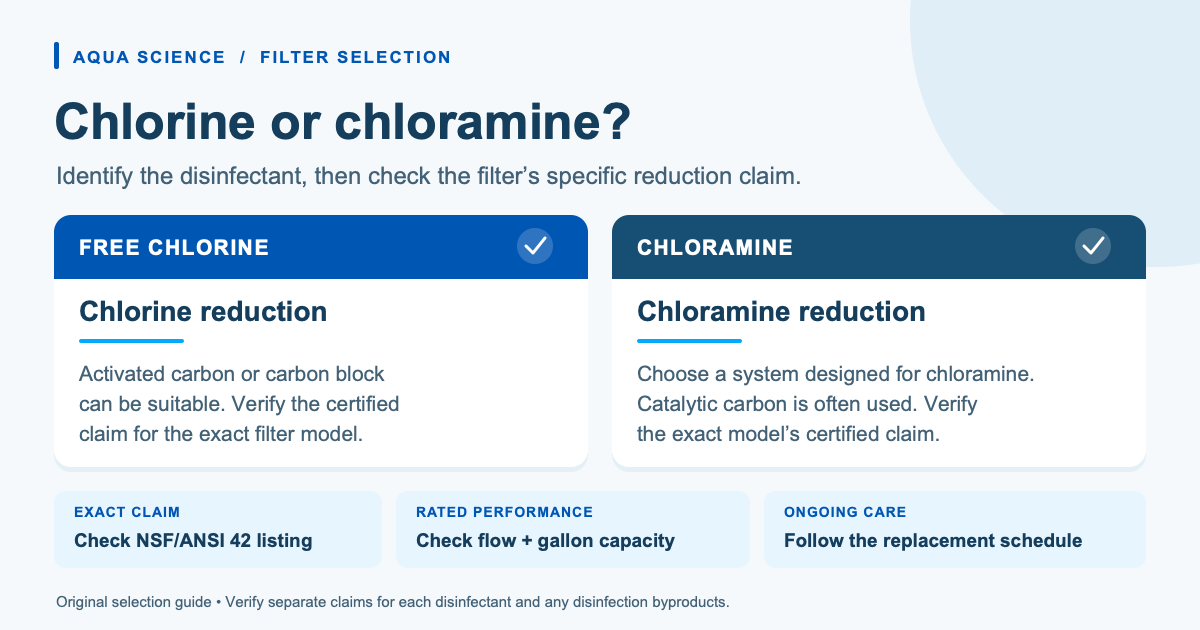
Two disinfectants, two claims to check
Free chlorine
An activated-carbon or carbon-block filter can be a practical choice for drinking and cooking water. Look for the exact model’s chlorine-reduction claim under NSF/ANSI 42, often listed with taste and odor.
Chloramine
Look specifically for chloramine reduction under NSF/ANSI 42. Catalytic carbon is often used for this more demanding treatment. A chlorine-only claim does not establish chloramine performance.
NSF/ANSI 42 covers aesthetic effects, including separate chlorine and chloramine reduction claims. Certification applies to the claims actually listed for a product. See NSF’s explanation of filtration standards and claims.
Read the listing, then the performance data sheet
A general “NSF certified” statement is not a complete description of what a system reduces. Before ordering, check these details for the exact system and replacement cartridge:
- Specific reduction claim. Find chlorine or chloramine by name. For lead, PFAS, byproducts or other concerns, look for the relevant separate claim.
- Rated service flow. Confirm the flow at which the stated reduction applies. A housing’s connection size or maximum flow is not the same as a verified treatment-flow rating.
- Rated gallon capacity. Check the capacity associated with that claim. Do not assume a chlorine capacity also applies to chloramine.
- Replacement schedule. Read both the time limit and usage limit, along with any conditions requiring earlier replacement.
- Operating conditions and parts. Check pressure, temperature and feed-water limits, plus the specified replacement cartridge or media.
Use the NSF certified-product directory to look up a listed model and its claims. NSF also cautions that certification to a standard does not establish reduction of every contaminant.
Why carbon contact time matters
Carbon treatment of chloramine involves a catalytic breakdown reaction. Catalytic carbon is designed to improve that reaction, but the media name alone does not establish a complete system’s performance. Flow, contact time, water chemistry and media condition still matter.
At higher flow, water spends less time in a given carbon bed. Size a whole-home system for the expected demand and the manufacturer’s treatment rating. There is no single contact-time number that can be applied to every household cartridge or tank.
The Water Quality Association’s chloramine fact sheet discusses activated carbon, catalytic carbon, contact time and the need to validate the selected equipment’s performance.
Choose where treatment belongs
Drinking and cooking water
A point-of-use carbon system, such as an under-sink filter with the correct claim, treats water at the selected tap. It can be a straightforward starting point when that is your goal.
Water throughout the home
A point-of-entry system treats water entering the house. Match its chlorine or chloramine performance to household flow and plan for the effects of removing the disinfectant residual.
Additional dissolved contaminants
Consider reverse osmosis when the complete system has verified claims for your additional concerns. Check its carbon stages and disinfectant compatibility as well as its membrane.
An RO membrane alone is not a reliable chloramine-removal strategy. WQA describes chloramine as difficult to remove by reverse osmosis. An RO system may pair its membrane with appropriate carbon treatment; verify the complete configuration and its maintenance instructions. NSF notes that most RO systems include additional filters.
Plan for what happens after carbon
For a private well with continuous chlorination, carbon removal belongs after the required disinfection contact time. Removing chlorine too early can interfere with the treatment’s purpose. Have a water-treatment professional confirm the sequence, contact capacity and monitoring plan. University of Nebraska–Lincoln Extension’s household chlorination guide explains the importance of contact time and carbon treatment following chlorination.
Follow the manufacturer’s cartridge or media replacement, flushing and sanitizing instructions. Track dates and water use; arrange performance checks appropriate to the system. Better taste alone does not verify continued treatment performance or microbiological safety. See CDC’s filter-maintenance guidance.
Keep taste preferences and health claims separate
Regulated exposure is different from excessive exposure. EPA lists irritation and stomach discomfort among potential effects of exposure above disinfectant limits; its chloramine entry also lists anemia. Those entries are not a description of what compliant tap water normally does. See EPA’s drinking-water regulations and health-effects table.
A filter is not a skin or hair treatment. EPA reports no known or anticipated adverse skin effects from chloraminated water meeting its standards. The reviewed drinking-water sources do not support a blanket claim that ordinary municipal exposure permanently damages skin or hair. Persistent dryness or irritation deserves evaluation by a healthcare professional rather than automatic attribution to the disinfectant. Read EPA’s monochloramine health information.
Disinfection byproducts are a separate issue. They form when disinfectants react with natural material in water. Studies have associated long-term exposure to certain byproduct mixtures with increased bladder-cancer risk. That is different from saying chlorine itself at normal tap-water levels causes cancer. Utilities must address both germs and regulated byproducts. NCI summarizes the byproduct research.
If byproducts are your concern, verify the relevant reduction claim. Reducing chlorine or chloramine does not, by itself, establish reduction of every byproduct—or of unrelated contaminants.
Two common shopping questions
Does a shower-filter certification cover chloramine?
Not automatically. NSF/ANSI 177 shower-filter certification addresses free available chlorine. Verify any chloramine claim separately; do not infer it from a shower-filter label or a promise about skin and hair.
Does better-tasting water mean every concern is addressed?
No. Taste and odor do not reliably establish water safety. Testing and the system’s specific claims are the basis for evaluating other contaminants.
Sources and further reading
- CDC: Water disinfection with chlorine and chloramine
- CDC: Choosing and maintaining home water filters
- EPA: Drinking-water regulations and disinfectant limits
- EPA: Common health questions about monochloramine
- NCI: Research on drinking-water contaminants
- NSF: Filtration standards and specific reduction claims
- NSF: Water-treatment standards, including RO and shower filters
- NSF: Certified drinking-water treatment units
- WQA: Chloramine technical fact sheet
- UNL Extension: Continuous chlorination for household water
Match treatment to your water
Bring us the water report and the filter claim
Aqua Science can help you review your disinfectant, treatment goal and household flow before choosing equipment. Have your utility report or well-water results, existing system details and the candidate filter’s specifications ready.