



Aqua Science • Water Knowledge
A pitcher filter and a whole-house system serve different jobs. The better choice depends on what is in your water, which outlets need treatment, and how much maintenance you can reliably manage.
Point-of-Use: Treatment Where You Drink
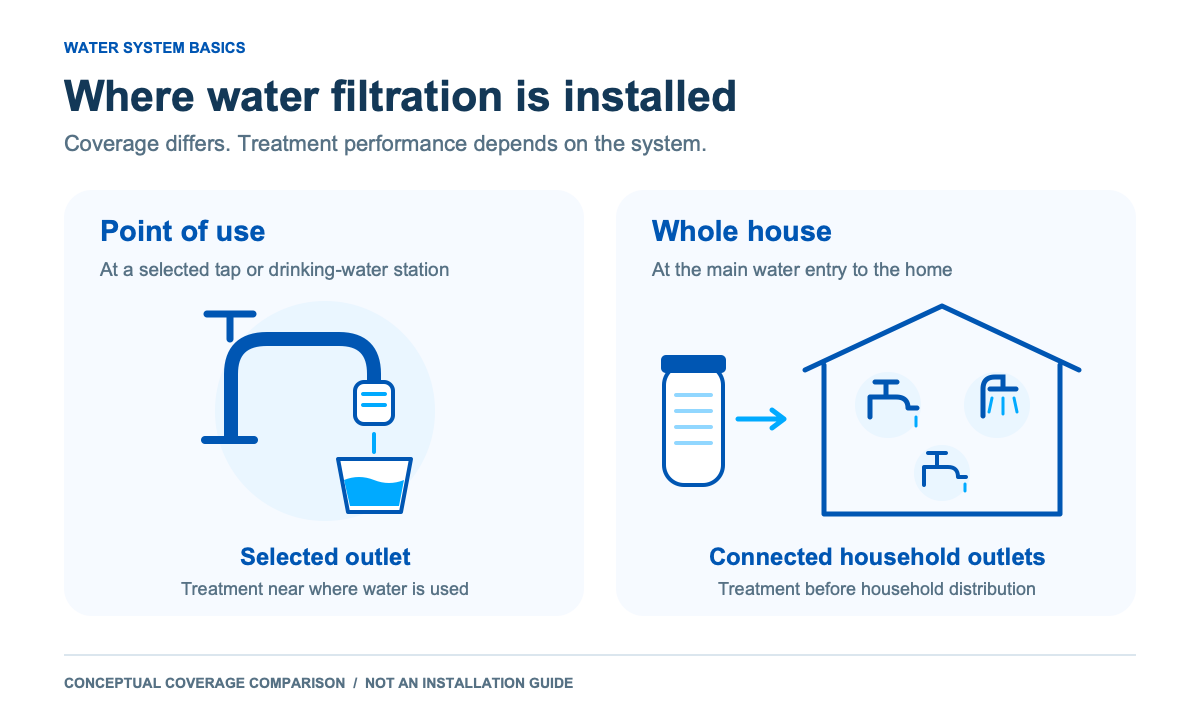
Pitchers, faucet-mounted filters, refrigerator cartridges, countertop units, and under-sink systems treat water at a particular point of use. They can be a practical choice when your priority is water for drinking and cooking.
The category covers many technologies. A basic carbon pitcher is not equivalent to a multi-stage reverse-osmosis system. Compare the actual model’s capacity and certified reduction claims, rather than treating all small filters as interchangeable.
Whole-House: Treatment at the Entry Point
A whole-house system treats water as it enters the home, supplying multiple fixtures. That broader coverage can be useful when a water problem affects bathing, laundry, or plumbing as well as the kitchen.
Coverage alone does not establish treatment performance. Sediment filtration, softening, iron treatment, pH correction, and disinfection address different needs. A single system may not solve every issue shown by a water test.
| Consideration | Point-of-use | Whole-house |
|---|---|---|
| Coverage | A selected tap or drinking-water supply | Multiple fixtures supplied downstream |
| Installation | Ranges from a refillable pitcher to an installed under-sink system | Installed in the incoming water line |
| Selection | Match drinking-water needs and the model’s treatment claims | Match household flow, water chemistry, and treatment goals |
| Maintenance | Cartridge changes and cleaning as specified | Filter or media service, and other model-specific care |
| Budget | Consider replacement cartridges as well as purchase price | Include installation, consumables, and ongoing service |
Replacement Is Part of Filtration
A filter is not a permanent barrier. Follow the manufacturer’s replacement schedule and rated capacity. Water that still tastes acceptable is not proof that a cartridge continues to reduce the contaminant you bought it for.
Keep pitchers and housings clean according to their instructions. CDC emphasizes proper upkeep and notes that many common pitcher and refrigerator filters are not designed to remove germs. Removing disinfectant from water throughout a home also changes the conditions in downstream plumbing, so whole-house treatment requires thoughtful selection and care.
Choose a System Around Your Water
- Identify the problem. Use relevant testing and available water-quality information.
- Define the coverage. Decide whether treatment is needed at one tap, throughout the home, or in a combination.
- Check the exact model. Verify its independent certifications, rated capacity, and operating requirements.
- Plan the upkeep. Price replacement parts and establish a service schedule before buying.
A whole-house system and a kitchen drinking-water unit can complement each other. Neither should be chosen on the assumption that bigger automatically means safer, or that every small filter performs the same way.
Build a Treatment Plan That Fits
Aqua Science can help you use your water-test results to compare options, coverage, and maintenance needs.
Explore Water Treatment